//
Hướng dẫn sử dụng tàu điện ngầm Seoul: Cách sử dụng tàu điện ngầm như người địa phương
Mọi thứ bạn cần biết về hệ thống tàu điện ngầm của Seoul - từ việc mua thẻ T-money đến thành thạo việc chuyển tuyến và tìm lối thoát hiểm tốt nhất.
subwaymetrotransportationt-moneyguideevergreenfirst-time
Seoul's subway system is one of the best in the world — clean, punctual, affordable, and easy to navigate even if you don't speak Korean. With 23 lines and over 700 stations, it connects virtually every corner of the Seoul metropolitan area. Here's everything you need to know to ride it like a local.
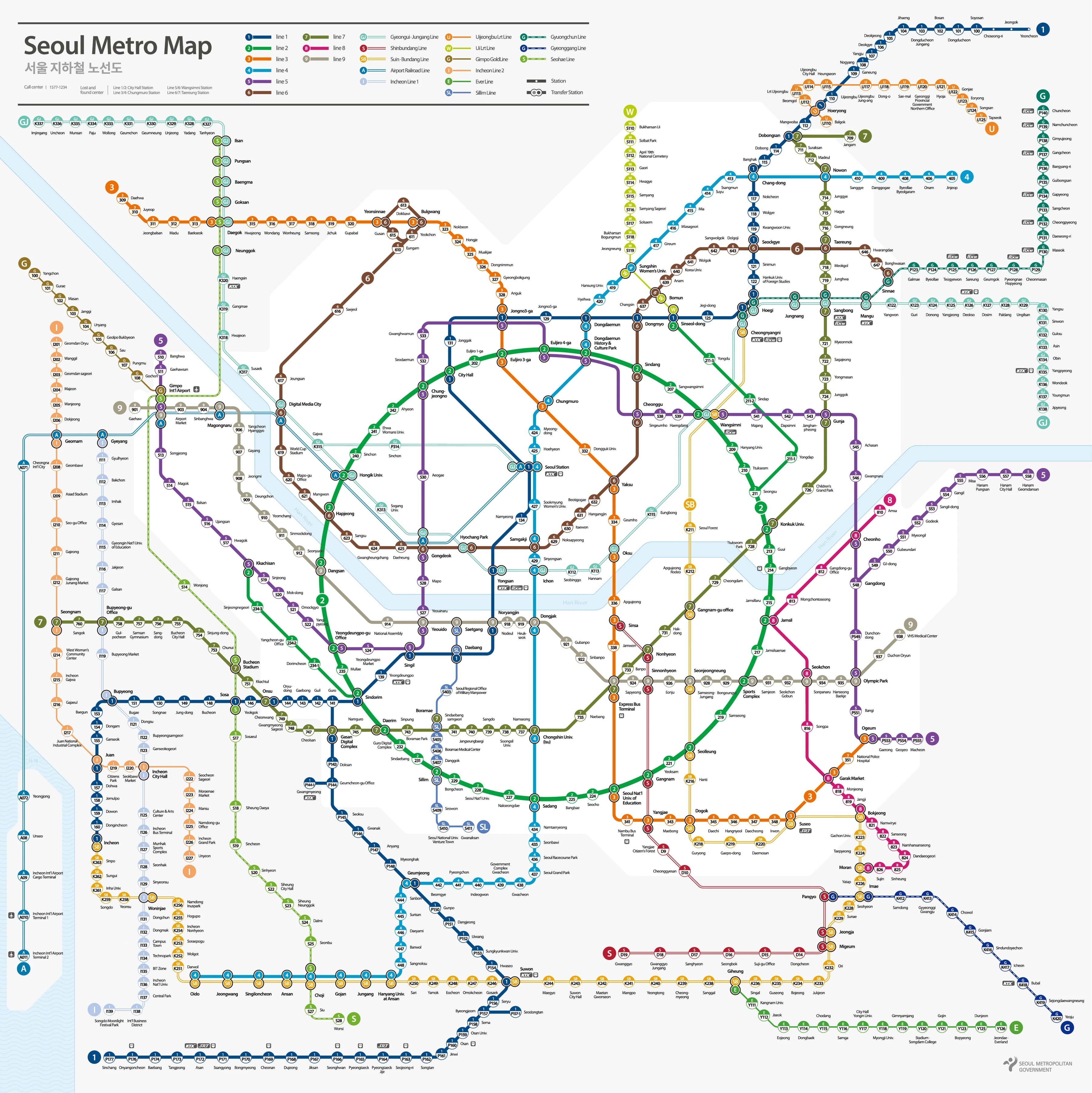
Bản đồ toàn tuyến tàu điện ngầm Seoul
Chạm vào bản đồ để mở toàn màn hình, sau đó thu phóng bằng cử chỉ hoặc cuộn để tìm bất kỳ ga nào. Đây là bản đồ chính thức được Chính quyền thành phố Seoul công bố — lần đầu tái thiết kế sau 40 năm — hiển thị toàn bộ 23 tuyến (Tuyến 1–9, tàu sân bay AREX, Shinbundang, Gyeongui–Jungang, Suin–Bundang, Gyeongchun, GTX-A và các tuyến liên vùng khác) cùng các ga trung chuyển. Cuộn xuống để xem chi tiết từng tuyến đưa bạn đến đâu.
Getting Your T-money Card
The T-money card is your key to Seoul's transit system. It works on all subways, buses, and even taxis.
Where to buy:
- Any convenience store (CU, GS25, 7-Eleven, Emart24) — just ask for "T-money"
- Vending machines inside subway stations
- Incheon Airport arrival hall convenience stores
Cost: ₩2,500 for the card itself (non-refundable), then load money onto it.
How to recharge:
- Convenience store counter — hand your card and cash to the cashier
- Subway station recharge machines — accept cash and some accept cards
- Load ₩10,000–20,000 to start; you can always add more
Why T-money beats single tickets:
- ₩100 discount per ride (₩1,250 vs ₩1,350)
- Free transfers between subway and bus within 30 minutes
- Works on taxis — just tap on the reader
- No need to buy a ticket every time
Tip: At the end of your trip, you can get a partial refund of your remaining balance (minus ₩500 processing fee) at any convenience store. Or just keep the card for your next visit — T-money cards don't expire.
Reading the Subway Map
Seoul's subway lines are color-coded and numbered, making navigation straightforward even without Korean.
Key lines for tourists:
| Line | Color | Key Stations |
|---|---|---|
| Line 2 (Green Circle) | Green | Hongdae, Sinchon, Gangnam, Jamsil, Seongsu |
| Line 1 | Dark Blue | Seoul Station, Jongno, Dongdaemun |
| Line 3 | Orange | Gyeongbokgung, Anguk (Insadong), Apgujeong |
| Line 4 | Light Blue | Myeongdong, Seoul Station, Dongdaemun |
| Line 6 | Brown | Itaewon, Noksapyeong, Hapjeong |
| Shinbundang | Red | Express to Gangnam from southern suburbs |
| Airport Railroad (AREX) | Blue/Orange | Incheon Airport ↔ Seoul Station |
Every station has a number (e.g., Hongdae is 239, Gangnam is 222). This is extremely useful when you can't read Korean — just match the numbers.
Station signage is in Korean, English, Chinese, and Japanese. Platform screens show the next train's destination and arrival time in real-time.
How to Ride: Step by Step
1. Enter the station Look for the subway entrance — marked with the line number and color. Most stations have 8–12 exits.
2. Tap in Hold your T-money card against the reader at the turnstile. The screen shows your remaining balance.
3. Find your platform Follow the signs showing your line number and direction. Platforms are labeled with the terminal station name.
4. Board the train Platform screen doors open with the train doors. Stand to the side and let passengers off first. Trains arrive every 2–5 minutes during peak hours, 5–10 minutes off-peak.
5. Ride Announcements are in Korean, English, Chinese, and Japanese. Digital displays above the doors show upcoming stations. Free Wi-Fi is available on all trains.
6. Transfer (if needed) Follow the transfer signs ("환승" in Korean, with the target line color and number). Some transfers involve long walks (5–10 minutes).
7. Tap out Tap your T-money at the exit turnstile. Your fare is calculated based on distance traveled.
Fares and Operating Hours
Fares (with T-money):
- Base fare (up to 10km): ₩1,250
- Each additional 5km: ₩100
- Most trips within central Seoul: ₩1,250–1,450
- Longest cross-city rides: up to ₩2,150
Operating hours:
- First trains: ~5:00–5:30 AM
- Last trains: ~11:30 PM–midnight (varies by line and station)
- Important: Last train times differ by direction. Check the Subway Korea app or station displays for exact times.
- Frequency: Every 2–3 minutes (rush hour), 5–8 minutes (off-peak), 8–10 minutes (late night)
Rush hours to avoid if possible:
- Morning: 7:30–9:00 AM
- Evening: 5:30–7:30 PM
- Lines 2 and 9 are the most crowded during rush hour
Transfer Tips
Transfers are free within 30 minutes when using T-money (subway ↔ subway, subway ↔ bus, bus ↔ bus).
Major transfer stations:
- Jongno 3-ga: Lines 1, 3, 5 — central hub near Insadong and palaces
- Dongdaemun History & Culture Park: Lines 2, 4, 5 — useful for reaching east Seoul
- Express Bus Terminal: Lines 3, 7, 9 — southern Seoul hub
- Yeouido: Lines 5, 9 — financial district and Han River parks
- Hapjeong: Lines 2, 6 — connects Hongdae area to Itaewon line
- Seoul Station: Lines 1, 4, AREX, KTX — the main transit nexus
Pro tip: When transferring, follow the colored floor markings — they guide you to the correct platform without reading signs.
Getting to Popular Districts by Subway
Seongsu (성수) — Line 2, Seongsu Station (Exit 3 or 4) Seoul's popup capital. Walk straight from Exit 3 into the main popup street.
Hongdae (홍대) — Line 2, Hongik University Station (Exit 9) The main Hongdae area is directly outside Exit 9. For AK Plaza exhibitions, use Exit 2.
Gangnam (강남) — Line 2, Gangnam Station (Exit 10 or 11) The main Gangnam-daero boulevard. For Apgujeong/Rodeo Street, take Line 3 to Apgujeong Station. For COEX Mall, Line 2 to Samseong Station.
Itaewon (이태원) — Line 6, Itaewon Station (Exit 1 or 4) Exit 1 for the main Itaewon strip. Exit 4 for the Haebangchon (HBC) side.
Myeongdong (명동) — Line 4, Myeongdong Station (Exit 6 or 7) Exit directly into the main shopping street. For Namsan Cable Car, Exit 3.
Jongno/Insadong (종로/인사동) — Line 3, Anguk Station (Exit 6) Exit 6 leads straight to Insadong's pedestrian street. For Gyeongbokgung Palace, Gyeongbokgung Station Exit 5.
Yeouido (여의도) — Line 5 or 9, Yeouido Station Exit 1 for IFC Mall. For cherry blossoms, head to Yeouinaru Station (Line 5).
Useful Apps for the Subway
- Subway Korea (iOS/Android): Offline subway map, route planner with transfer info, estimated travel time, and real-time departure info. Available in English and Japanese. The single best app for navigating the subway.
- Naver Map: Includes subway routing with exit number recommendations and walking directions from the exit to your destination.
- KakaoMap: Similar to Naver Map with subway integration.
How to plan a route:
- Open Subway Korea → tap your starting station → tap your destination
- The app shows: fastest route, number of transfers, total time, fare, and which car to board for the fastest transfer
- "Which car to board" is a game-changer — it tells you to board car #4 so you exit right in front of the transfer escalator
Subway Etiquette
A few unwritten rules that locals follow:
- Priority seats (at the end of each car, marked in a different color) are reserved for elderly, pregnant, and disabled passengers. Even if the train is packed and these seats are empty, Koreans will not sit in them.
- Keep quiet. Koreans rarely talk loudly on the subway. Phone calls are kept short and quiet.
- Stand on the right on escalators to let people walk on the left.
- Let passengers exit first before boarding.
- Eating and drinking is not allowed on the subway, though water is generally fine.
- Backpacks: In crowded trains, move your backpack to your front or place it between your feet.
Late Night Options
Missed the last train? Don't panic:
- Night buses (올빼미버스): Seoul operates late-night bus routes ("N" prefix) from midnight to 5 AM. Routes N13, N26, and N37 cover popular tourist areas. Fare: ₩2,150 with T-money.
- Taxis: Readily available everywhere. Late-night surcharge (20%) applies midnight–4 AM.
- KakaoTaxi: Usually faster than hailing a taxi on the street at night.
- 24-hour jjimjilbangs: Korean spas accept overnight guests for ₩10,000–15,000 — a popular budget option.
Tip: Save your hotel address in Korean on your phone. Show it to the taxi driver — it's faster and avoids miscommunication.
Hướng dẫn theo từng tuyến
Mỗi tuyến tàu điện ngầm Seoul phục vụ một khu vực khác nhau của thành phố. Chạm vào tuyến bất kỳ để xem mẹo du lịch theo từng ga, các địa điểm nổi bật và gợi ý trung chuyển.
- Tuyến 1 (Xanh đậm) — Ga Seoul, Jongno 3-ga, Dongdaemun, chợ đồ cũ Dongmyo
- Tuyến 2 (Xanh lá – vòng tròn) — Hongdae, Gangnam, Seongsu, Jamsil — tuyến du lịch quan trọng nhất
- Tuyến 3 (Cam) — Cung Gyeongbokgung, Insadong, Làng Hanok Bukchon, Apgujeong
- Tuyến 4 (Xanh nhạt) — Myeongdong, Tháp Namsan, Dongdaemun, Hyehwa
- Tuyến 5 (Tím) — Gwanghwamun, Yeouido, Công viên Olympic, sân bay Gimpo
- Tuyến 6 (Nâu) — Itaewon, Haebangchon, Hapjeong, công viên World Cup
- Tuyến 7 (Ô liu) — Gangnam, Đại học Konkuk, khu giải trí Ttukseom, bến xe tốc hành
- Tuyến 8 (Hồng) — Jamsil, Hồ Seokchon, Tháp Lotte World
- Tuyến 9 (Vàng) — Sân bay Gimpo, Nghĩa trang Quốc gia, tuyến tốc hành đến Gangnam
- Tàu sân bay AREX — Sân bay Incheon ↔ Ga Seoul trực tiếp
- Tuyến Shinbundang (Đỏ) — Tốc hành Gangnam ↔ Pangyo
Bình luận
Đang tải bình luận…